
Student activity
The case, a patient snapshot, a recognize-cues worksheet and every item with space for reasoning, in Word.
A complete, ready-to-teach clinical judgment curriculum. Each case gives students a patient who feels real, competing needs to sort by urgency and decisions to make, with the documents and scored items faculty need to teach and assess it.
No preparation from scratch. Assign a case and students can start in minutes.
The case, a patient snapshot, a recognize-cues worksheet and every item with space for reasoning, in Word.
The keys, rationales and model answers for every item, visible to staff only.
The training EHR the case is built on, starting with the handoff report.
Objective items are scored when students save; open responses are graded by faculty.
Cases build from communication and noticing cues to acting in emergencies and working in teams. Each names its level, its number of items and its patient.
Therapeutic communication, hard news, culturally responsive teaching, interpreters and de-escalation.
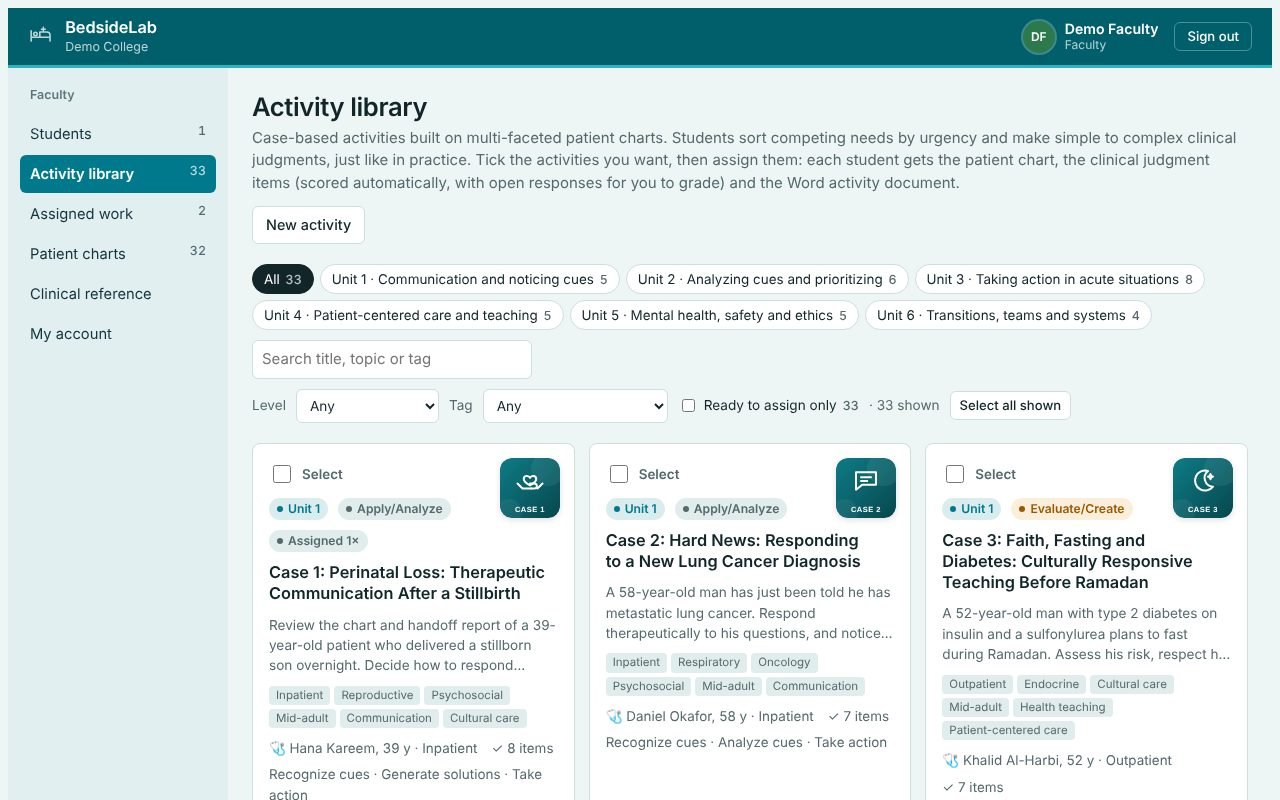
Review the chart and handoff report of a 39-year-old patient who delivered a stillborn son overnight. Decide how to respond verbally and non-verbally as her primary nurse, while still watching for postpartum complications.
A 58-year-old man has just been told he has metastatic lung cancer. Respond therapeutically to his questions, and notice the new physical complaint that could be an oncologic emergency.
A 52-year-old man with type 2 diabetes on insulin and a sulfonylurea plans to fast during Ramadan. Assess his risk, respect his decision, and build a safe fasting plan with him.
A 71-year-old Spanish-speaking woman with new atrial fibrillation is going home on warfarin. Use a professional interpreter, find the medication and safety risks in her chart, and confirm understanding with teach-back.
A 46-year-old man admitted with pancreatitis becomes agitated, tremulous and frightened on day 3. Use de-escalation, recognize alcohol withdrawal delirium, and act on the withdrawal protocol safely.
Recognizing deterioration early: sepsis, heart failure, DKA, stroke and hyperkalemia.
Review the chart and handoff of a 17-year-old with a C6 spinal cord injury in inpatient rehabilitation. List and prioritize her nursing problems, find the concerns in the admission assessment, and respond when she develops a pounding headache.
On postoperative day 2 after a colectomy, a 63-year-old man is "just a bit off." Connect subtle changes in vital signs, mentation, urine output and labs, escalate, and start the sepsis bundle.
A 74-year-old man with heart failure is admitted after a family wedding and running out of his diuretic. Prioritize his problems, catch a medication safety issue on day 2, and evaluate his response to diuresis.
A 15-year-old with type 1 diabetes stopped his insulin during a stomach virus. Recognize DKA, prioritize fluids, insulin and potassium safely, and watch for cerebral edema.
A 68-year-old woman arrives with sudden right-sided weakness and trouble speaking. Use the last-known-well time, screen for thrombolysis, lower her blood pressure to a safe range, and protect her airway.
A 79-year-old man on an ACE inhibitor and spironolactone took ibuprofen for gout during a bout of diarrhea. His potassium is 6.8 with ECG changes. Find the causes, give treatment in the right order, and evaluate the result.
Hemorrhage, magnesium safety, opioid-induced respiratory depression, transfusion reactions, anaphylaxis, hypoglycemia, asthma and PE.
Forty minutes after delivering a 4.3 kg baby, a 31-year-old mother has a boggy uterus and heavy bleeding. Act in the right order, choose uterotonics safely for her history, and evaluate the response.
A 28-year-old at 34 weeks has severe-range blood pressure, a headache and low platelets. Recognize the severe features, give antihypertensive treatment and magnesium safely, and catch magnesium toxicity.
On the night after surgery, a 58-year-old woman with sleep apnea on a hydromorphone PCA is hard to wake with slow, shallow breathing. Identify the risk factors, rescue her, and prevent recurrence.
A 45-year-old woman with a GI bleed develops chills, fever, back pain and hypotension 15 minutes into a red cell transfusion. Stop the reaction, recognize the type, and find the safety failure.
Five minutes into his first dose of ceftriaxone, a 34-year-old man develops hives, throat tightness, wheezing and hypotension. Give epinephrine first, support him, and plan for a biphasic reaction.
An 81-year-old woman who was NPO for a procedure is found sweaty and confused at 10:15. Treat severe hypoglycemia correctly when she cannot swallow safely, then trace the system causes.
An 8-year-old arrives in the emergency department with wheezing and retractions after a cold. Assess severity, give treatment in order, recognize the danger of a "quiet chest," and teach an asthma action plan.
On postoperative day 3 after a hip replacement, a 66-year-old woman who refused her anticoagulant injections suddenly becomes short of breath. Recognize a pulmonary embolism and act, and plan how the refusal should have been handled.
Shared decision-making, ostomy teaching, polypharmacy and falls, and newborn jaundice.
A 61-year-old taxi driver has uncontrolled blood pressure and newly diagnosed stage 3b chronic kidney disease. Using the QSEN competency of patient-centered care, uncover his values, preferences, health literacy and barriers before any plan is made.
Return to Samuel Mensah's chart. Recreate his encounter with the health care team using a patient-centered approach: weigh options against his priorities, write SMART goals with him, and evaluate the plan at follow-up.
A 41-year-old woman with Crohn's disease has a new ileostomy. Assess the stoma, notice the early signs of dehydration from high output, and plan teaching that addresses her readiness and her body image.
An 84-year-old woman admitted after a fall takes 13 medications. Find the medicines that raise her fall risk, interpret orthostatic vital signs and her low sodium, and lead a patient-centered deprescribing conversation.
A 3-day-old exclusively breastfed newborn has rising bilirubin, 9% weight loss and few wet diapers, and his first-time mother has sore nipples. Interpret the findings, deliver phototherapy safely, and support breastfeeding.
Suicide risk, lithium toxicity, dementia care without restraints, goals of care and intimate partner violence.
A 22-year-old student is in the emergency department after an intentional acetaminophen overdose. Treat the medical emergency, assess suicide risk directly and compassionately, and keep her safe.
A 49-year-old man stable on lithium for years develops vomiting, coarse tremor and confusion after a new diuretic, an NSAID and a stomach bug. Recognize toxicity, act, and teach to prevent it.
An 86-year-old man with Alzheimer's disease and a urinary tract infection becomes agitated every evening, tries to leave "to go to work," and strikes out during care. His son asks for restraints. Find the unmet needs and create a person-centered plan.
A 77-year-old woman with metastatic pancreatic cancer is dying. Her advance directive declines life support, her daughter is her health care proxy, and her son wants "everything done." Recognize the dying process, manage symptoms, and support an ethical family conversation.
At a 24-week prenatal visit, a 27-year-old woman has bruises at different stages of healing, a partner who answers for her, missed appointments and a positive depression screen. Create a private space, ask, document and plan for safety.
Medication costs after discharge, early warning scores and SBAR, delegation, and infection prevention.
A 56-year-old rideshare driver with a high-deductible plan is going home after a stent with six new prescriptions. Estimate his monthly costs from the chart, find resources, decide which medicine he must never stop, and plan for adherence.
A 70-year-old man with pneumonia is deteriorating at 02:00. Calculate his NEWS2 score, write an SBAR, and know what to do when the on-call physician says to "keep an eye on him."
You have five patients on a medical-surgical unit, an LPN and a nursing assistant. Decide whom to see first, what to delegate to whom, and how to communicate a clear delegation.
A 72-year-old man on antibiotics and a proton pump inhibitor develops profuse diarrhea and tests positive for C. difficile. Implement the right precautions, catch an unsafe practice, and teach his family.

The course ends where nursing practice gets most complex: transitions of care, speaking up, delegating across a full assignment and protecting every patient on the unit.
A 56-year-old rideshare driver with a high-deductible plan is going home after a stent with six new prescriptions. Estimate his monthly costs from the chart, find resources, decide which medicine he must never stop, and plan for adherence.
A 70-year-old man with pneumonia is deteriorating at 02:00. Calculate his NEWS2 score, write an SBAR, and know what to do when the on-call physician says to "keep an eye on him."
You have five patients on a medical-surgical unit, an LPN and a nursing assistant. Decide whom to see first, what to delegate to whom, and how to communicate a clear delegation.
A 72-year-old man on antibiotics and a proton pump inhibitor develops profuse diarrhea and tests positive for C. difficile. Implement the right precautions, catch an unsafe practice, and teach his family.
The built-in cases are a starting point, not a limit. Review each key against your local policies, and change anything you need with the activity builder.
Each college gets the complete library on day one.