Block 2.1 Motion and Senses for medical colleges

Neuroscience at the bedside, one patient at a time.

Medical students meet the nervous system, hearing, balance and vision in realistic patient charts: they find the cues, localise the lesion and decide what to do, and every answer is graded the moment they submit.

  • 16 case-based activities in eight units, with answer keys
  • 130 items, open responses scored against a rubric
  • 12 individual and 4 group practicals
  • Runs in the browser, nothing to install
MotionSensesLab EHR · Handoff report
The MotionSensesLab training EHR: the patient storyboard beside the handoff report
16Case-based activities
130Items, graded automatically
8Units of Block 2.1
16Patients, 5 to 78 years
The platform

Everything for a Motion and Senses block

Explore the platform →

A training EHR for every case

Storyboard, notes, examination tables, vitals, results, MAR and orders

Handoff reports you can hear

Read or listen to the team going off duty

Graded the moment they submit

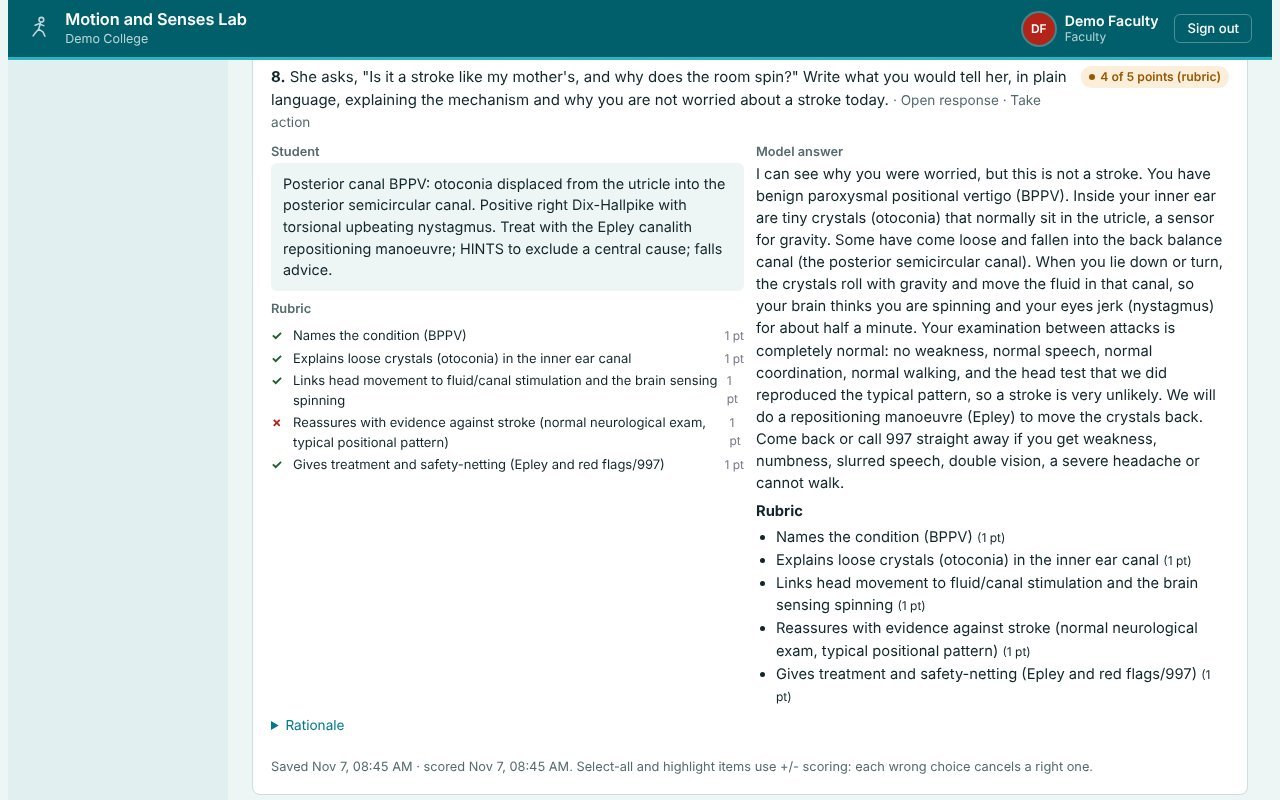
Grade, feedback and rationales straight away

Open responses with rubrics

Key points and terms score written answers too

Excel grading sheets

Item scores, item analysis and a course gradebook

Course reference built in

Pathways, reflexes, hearing, vision, statistics
Activity
Items beside the patient chart
Built around clinical reasoning

From the history to the decision

Each case connects the basic science of the block to a patient: students read the chart the way a clinician does and reason step by step.

  1. Read the history and the handoff
  2. Find the cues in the examination
  3. Localise the lesion
  4. Weigh the differential
  5. Choose tests and treatment
  6. Explain it to the patient
Curriculum

16 cases in the eight units of Block 2.1

Each case has a patient chart, items with rationales, a student Word activity and a faculty answer key.
See all 16 cases →
Unit 1

Muscle Force

2 cases
  • Myasthenia gravis
  • Duchenne muscular dystrophy (group)
Unit 2

Sensory System

2 cases
  • Charcot-Marie-Tooth or diabetic neuropathy
  • Brown-Séquard syndrome
Unit 3

Central Force Regulation

2 cases
  • Code stroke: left MCA infarct (group)
  • Amyotrophic lateral sclerosis
Unit 4

Central Motor Coordination

2 cases
  • Right cerebellar infarct
  • Parkinson's disease
Unit 5

Cognition

2 cases
  • Early Alzheimer's disease
  • Chronic subdural haematoma
Unit 6

Global Health & Statistics

2 cases
  • A blood pressure audit
  • Screening and P values (group)
Unit 7

Hearing & Equilibrium

2 cases
  • Positional vertigo
  • Conductive and sensorineural hearing loss
Unit 8

Vision

2 cases
  • The visual pathway (group)
  • Retinopathy, cataract and angle closure
Inside MotionSensesLab

See what students and faculty work with

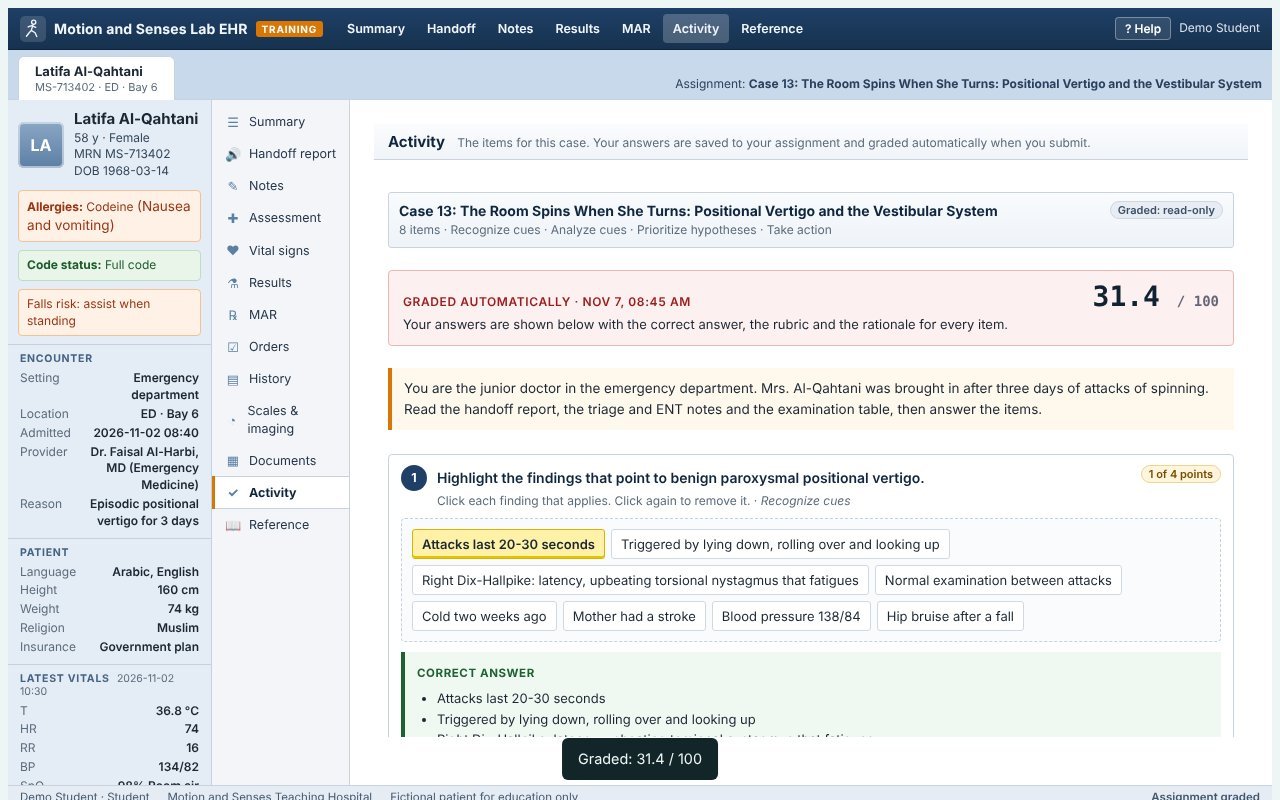
Activity
Items in the chart's Activity tab

Answer the items beside the chart.

Vital signs
A vital sign flowsheet with abnormal values flagged

Read the record like a clinician.

Grading
The automatic grade with every answer beside the key and rationale

A grade and feedback the moment they submit.

For colleges

One workspace for your medical block

For colleges →
Students working together at laptops

College admin

  • Manage faculty accounts
  • Add your logo and colours
  • Follow every assignment

Faculty

  • Assign cases to a class or a team
  • Write items and rubrics, or build charts from Synthea
  • Review automatic grades and download Excel sheets

Student

  • Review a full patient chart
  • Submit and see the grade at once
  • Learn from rationales and the course reference
How it works

From assignment to grade in four steps

  1. Faculty assign

    Pick cases, choose a class or team, set a due date

  2. Students review the chart

    Each case opens its patient chart and handoff report

  3. Answer and submit

    Answer the items in the chart and submit for grading

  4. Graded at once

    Grade, feedback and rationales; faculty review and adjust

Security & privacy

Safe by design

Fictional patients only; students never see keys, rationales or rubrics before their work is graded.

How we protect your program →
  • No real patient data
  • Role-based access
  • Colleges kept separate
  • Keys, rationales and rubrics stay private until graded
  • Same secure account as ChartLab
  • Nothing to install

Bring Motion and Senses to life for your students

Case-based practice for Block 2.1, graded automatically.