
Student activity sheet
The case, the questions and the coding tasks in an editable Word document.
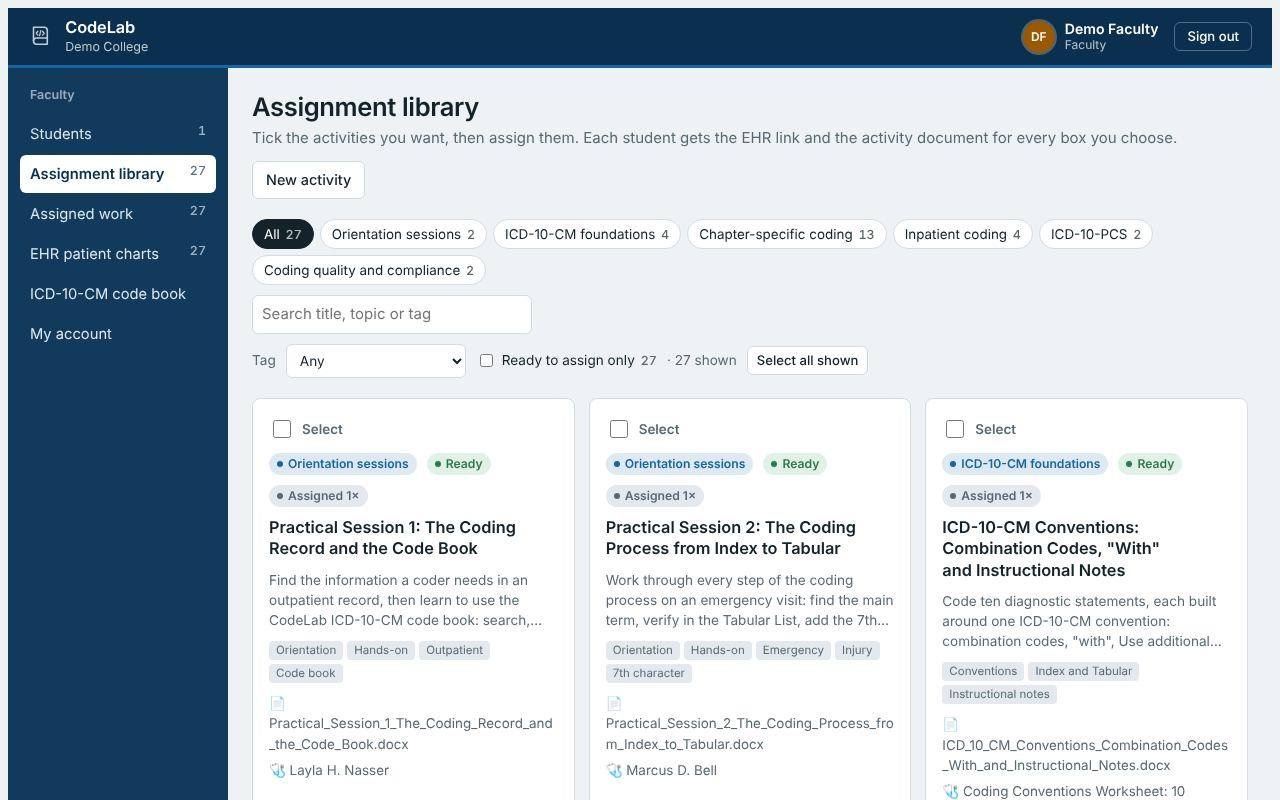
A complete, ready-to-teach coding curriculum. Each activity gives students a real record to code from, and comes with the documents faculty need to teach and assess it.
No preparation from scratch. Assign an activity and students can start in minutes.
The case, the questions and the coding tasks in an editable Word document.
The expected codes, their sequence and the reasoning behind them, visible to staff only.
A record with the documentation, results and notes the right codes come from.
Students enter their codes in the Coding activity, with edits; faculty see them when grading.
Activities are grouped by topic, from first steps in the code book to inpatient coding, procedures and billing. Each names its level and the record students code from.
The coding record and the code book: where to find what a coder needs.
Find the information a coder needs in an outpatient record, then learn to use the CodeLab ICD-10-CM code book: search, read instructional notes and check whether a code is billable.
Work through every step of the coding process on an emergency visit: find the main term, verify in the Tabular List, add the 7th character and the external cause codes.
Conventions, combination codes, outpatient rules and sequelae.
Code ten diagnostic statements, each built around one ICD-10-CM convention: combination codes, "with", Use additional code, Code first, Excludes notes and laterality.
Code an office visit for chest pain where the cause is not yet known. Apply the outpatient rules for uncertain diagnoses, symptoms, chronic conditions and history codes.
Code a short inpatient stay where the final diagnosis is documented as "probable", then compare it with how the same emergency visit would be coded if the patient had gone home.
Code a follow-up visit for the residual effects of a stroke, together with diabetes, chronic kidney disease and hypertension, applying the sequela and "with" conventions.
The chapters coders meet every day, from diabetes and hypertension to sepsis, pregnancy and injuries.
Code an endocrinology visit for type 2 diabetes with hyperglycemia, polyneuropathy, retinopathy and a diabetic foot ulcer, on both insulin and an oral drug.
Code an admission for acute on chronic diastolic heart failure in a patient with hypertension and CKD, applying the hypertension table logic, required additional codes and BMI rules.
Code an ICU admission for sepsis due to an E. coli urinary tract infection with septic shock and organ dysfunction, applying the sepsis sequencing guidelines.
Code an admission for acute respiratory failure due to a COPD exacerbation with acute bronchitis, and decide which condition is the principal diagnosis.
Code an admission for a type 1 NSTEMI with coronary artery disease, then build the ICD-10-PCS code for a percutaneous coronary intervention with a drug-eluting stent.
Code two encounters for a patient with metastatic breast cancer: an outpatient chemotherapy visit and an admission for anemia caused by the chemotherapy.
Decide whether a hip fracture in a patient with osteoporosis is coded as traumatic or pathological, then code the admission and the follow-up visit with the correct 7th characters.
Code four emergency visits that involve drugs, deciding for each whether it is an adverse effect, a poisoning or an underdosing, and sequencing the T codes correctly.
Code a vaginal delivery with a perineal laceration and a GBS-positive mother, including weeks of gestation, outcome of delivery and the ICD-10-PCS delivery and repair codes.
Code a late-preterm newborn's birth admission, sequencing the Z38 code first and applying the rules for birth weight, gestational age and perinatal conditions.
Code an admission for alcohol withdrawal delirium with cirrhosis, depression and electrolyte problems, applying the substance use hierarchy and combination codes.
Code an annual preventive visit with abnormal findings, social determinants of health, family history and an immunization.
Code an admission for Pneumocystis pneumonia in a patient with AIDS, applying the HIV sequencing rules and the differences between B20, Z21 and R75.
Principal diagnosis, POA indicators and provider queries.
Select the principal diagnosis for six short inpatient cases, each testing a different rule in Section II of the Official Guidelines.
Decide which secondary diagnoses are reportable for a nine-day stay, code pressure ulcers using the wound nurse's staging, and assign a POA indicator to every code.
Code a heart failure admission as documented, identify where the documentation does not reflect the clinical picture, and write compliant, non-leading provider queries.
Code a complete stroke admission: the cerebral infarction with its cause, the acute neurologic deficits, the NIHSS score, comorbidities and the thrombolytic procedure.
Root operations and coding procedures from operative reports.
Build twelve ICD-10-PCS codes from procedure statements, choosing the root operation, body part, approach, device and qualifier for each.
Read an operative report for a laparoscopic cholecystectomy converted to open, then assign the ICD-10-CM diagnosis codes and the ICD-10-PCS procedure codes.
Validating codes in an audit and checking office visits.
Audit ten coded encounters, find and classify each coding error, calculate the accuracy rate and recommend an education topic for the coding team.
Code eight short office visits for timed practice. Record your start and end time to measure productivity alongside accuracy.
Claims, denials and appeals, worked as a team.
In teams of four, take an inpatient Medicare stay from registration to a clean claim: verify patient access data, code the stay, correct the revenue lines and approve a final UB-04.
In teams, review four physician-office claims before they are sent: correct the ICD-10-CM codes, link each service to the right diagnosis, and fix place of service, modifiers and duplicate lines.
In teams, work a payer remittance with six denied or adjusted claims: read the adjustment codes, find each root cause in the documentation, decide the right action, and write an appeal letter.

The billing activities are group work: students share one set of answers, and faculty grade the team together or adjust one student’s grade.
In teams of four, take an inpatient Medicare stay from registration to a clean claim: verify patient access data, code the stay, correct the revenue lines and approve a final UB-04.
In teams, review four physician-office claims before they are sent: correct the ICD-10-CM codes, link each service to the right diagnosis, and fix place of service, modifiers and duplicate lines.
In teams, work a payer remittance with six denied or adjusted claims: read the adjustment codes, find each root cause in the documentation, decide the right action, and write an appeal letter.
The built-in activities are a starting point, not a limit. Your faculty can change anything, and their changes are kept safe when CodeLab’s own content is updated.
Each college gets the complete library on day one.